Complaint Management & customer retention

Complaint Management: turn complaints into relationships.

Most unhappy customers never complain. They simply leave. A customer who complains is still talking to you, and that is why complaints are the most underestimated source of growth in a company. That is the task of complaint management, and we train service and sales teams to use that moment well.

28
years of passion for sales
93.000
trained participants
5
steps in the conversation model
540
loyal customers

Figures from training and consulting work since 1998, across sectors.

What is Complaint Management?

Complaint management is a planned way for a company to handle complaints and criticism: accept complaints, process them, evaluate them and remove their causes. The aim is not to close the case, but to keep the customer.

We use a five stage model for this, from accepting the complaint to measurable control. The next section shows what needs to happen at each stage.

The hidden goldmine

The costliest customers are the ones who say nothing.

A quiet departure costs twice: the revenue and the insight into why they left. A complaint, by contrast, is an invitation. It says: I want this to work. What your team does in the next few minutes decides whether you lose the customer or keep their loyalty.

Without a system

The complaint is processed

Everyone in the team responds differently, so the outcome depends on the day.
The case is closed, but the cause remains.
Staff pick up the phone with a knot in their stomach.
No one knows whether the customer stayed.
With a system

The complaint becomes a turning point

A shared conversation framework that everyone in the team can use.
An individual case becomes a clue to the process behind it.
The team handles difficult conversations with confidence, instead of fearing them.
The customer feels valued and stays, often more loyal than before.
Customer service team member on the phone
The moment that decides
There are only a few seconds between complaint and response. They decide everything that follows.
The conversation structure

The 5-stage model.

Not a script to read out, but a clear structure that holds even when a customer gets loud. Drawn from Achim Jaeger's book and practised in training on your own cases.

01
Acknowledge
Listen without defending. The customer first needs to feel that their criticism has been heard.
02
Understand
Ask questions until the real issue is on the table. Often, it is not the one first named.
03
Resolve
A firm commitment, not vague reassurance. Specific, scheduled, achievable.
04
Act
What was promised actually happens, within the agreed timeframe. This is where trust, or cynicism, is created.
05
Follow up
The call hardly anyone makes. It is exactly what turns a saved customer into an advocate.

Stages 04 and 05 decide the effect. In practice, they are the steps most often skipped.
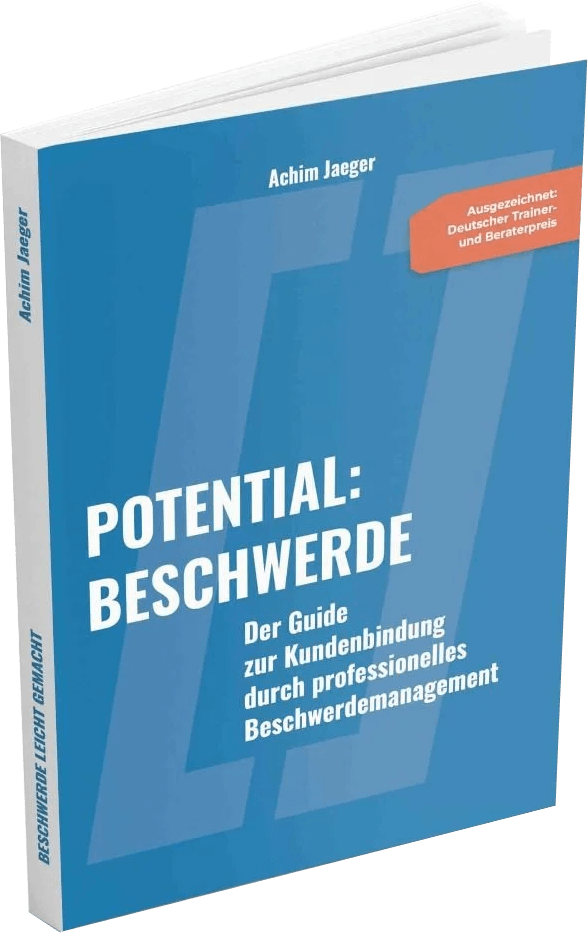
Book Potential: Complaint by Achim Jaeger
Mindset before technique

No guide can save a conversation that is already lost in your head.

Technique can be taught in a day. The mindset behind it is the real work: hearing a complaint not as an attack, but as information. Once you have internalised that, you no longer need a script.

That is exactly what Achim Jaeger's book "Potential: Beschwerde". It is the basis for this training: six chapters from mindset and the 5-stage model to measurable control. For the award-winning customer recovery concept Vertriebsimpuls received the Trainer- und Beraterpreis (the German Trainer and Consultant Award) from BaTB in 2015.

View the book in detail
Formats

Four ways forward, depending on where you are.

Every format works with your real cases, not sample examples. You bring the conversations that are genuinely difficult day to day.

01
In-house training
One to two days with the full service team. The 5-stage model, practised on your own complaints.
02
Escalation workshop
For the really hard cases: angry customers, public criticism, mistakes on your side. De-escalation that holds.
03
Leadership module
How managers set the framework: room to decide, backing and how to deal with repeat errors.
04
Process & control
So individual cases become insight: recording, key figures and the path from symptom to cause.

It usually starts with training and grows into process work. Our Approachexplains how we work in general. For sales itself, see our sales training for B2B teams..

Who it is for

Wherever customers get in touch.

Complaints rarely land in just one place. That is why we train the chain, not a single link.

Customer service & hotline
The first voice the customer hears when something has gone wrong.
Internal sales & fulfilment
Where promises are kept and trust is built or broken.
Sales & key accounts
The person who built the relationship often decides whether it can be saved.
Managers
They set the scope in which the team can act at all.
Quality & processes
So recurring cases finally become improvements.
Voices on the impact

When customers feel valued.

“

We became enthusiastic brand ambassadors, and it was great fun.

Isolde Troy
Kulturhäuser-Betriebsgesellschaft · Kunsthaus Bregenz
“

Empowered personalities now sell our offering almost by themselves, without pressure or targets.

Karl Nitsche
Managing Director · YachtHotel Helvetia
“

New impetus for customer acquisition and valuable tips for guiding conversations.

Otto E. Vogel
Managing Director · CommuniGate

You can find all testimonials from 28 years on the Clients page.

What does your toughest complaint sound like?

The next angry customer will call anyway.

The only question is what happens afterwards. In the free discovery call, we look at your typical cases and tell you honestly where the greatest leverage lies.

Book a discovery call +49 89 97 89 43 40